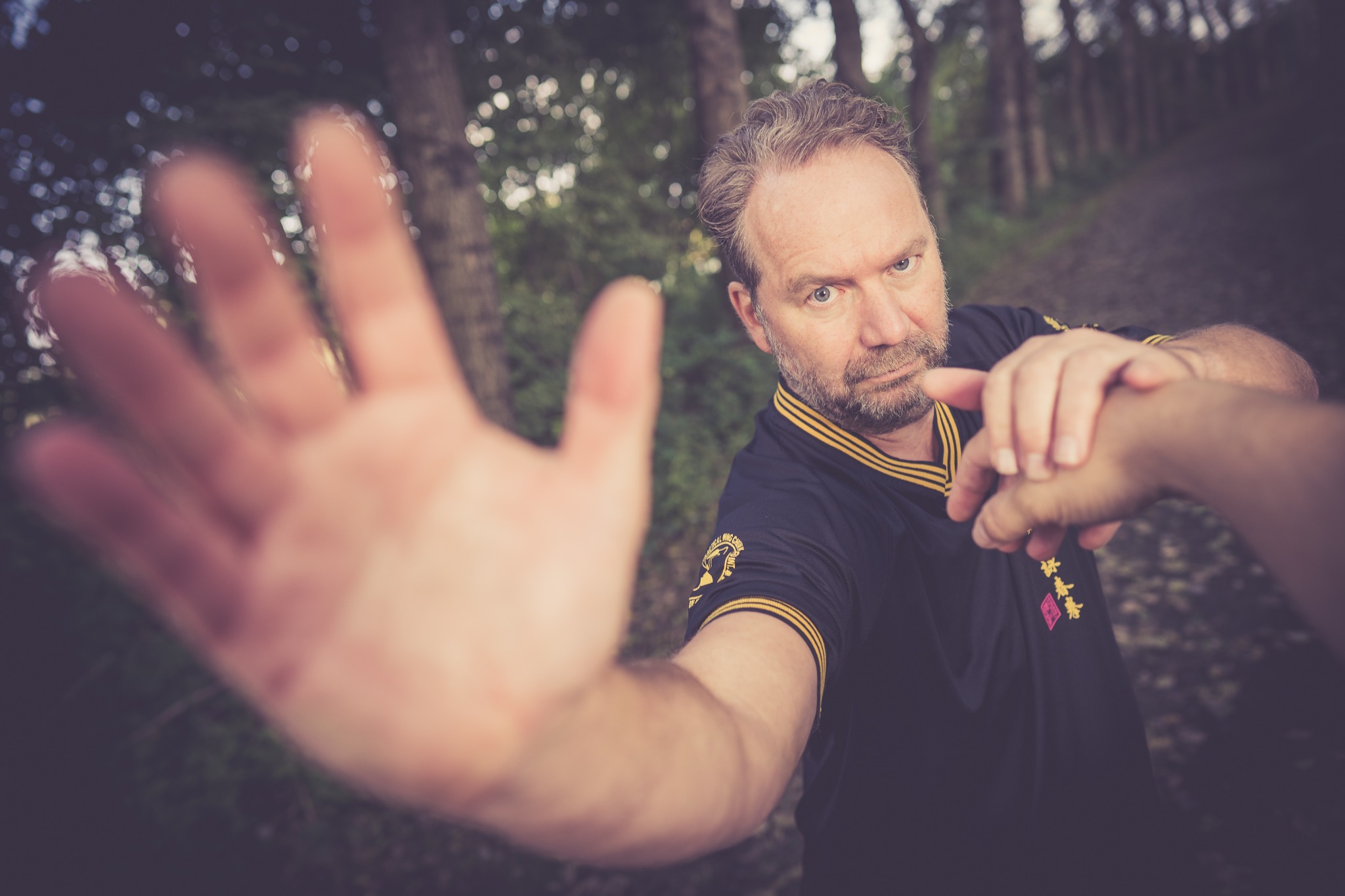
Cham Kiu: Learning to Move as One
Siu Nim Tau teaches us how to organise the body before movement begins. Cham Kiu asks the next question: can that structure survive when we turn, step, change direction and meet pressure?
This is why Cham Kiu is more than simply the second empty hand form of Wing Chun. It is the stage at which the principles developed in relative stillness must become useful in motion. The form teaches us how to create contact, control distance and move the body as one connected unit. New techniques appear, but the real subject of Cham Kiu is not the techniques themselves. It is the changing relationship between our body, our opponent and the space between us.
Searching for the Bridge
The name Cham Kiu is usually translated as searching for the bridge. Cham can suggest searching, seeking, locating or even sinking. Kiu means a bridge or connection. In Wing Chun, that bridge is often associated with contact between the arms, but it can also be created through the legs or the body. Any meaningful connection through which we can feel, influence or control an opponent can function as a bridge.
Without a bridge, there is no close range exchange. We first need to create the connection, then maintain it and finally control it. This is one of the major differences between Siu Nim Tau and Cham Kiu. During Siu Nim Tau training, the bridge is generally assumed to be available. In Cham Kiu, the opponent is farther away, moving and less willing to offer contact. We therefore learn to chase the opponent and bridge the gap.
Chasing does not mean running after arms or following every movement blindly. It means positioning ourselves so that we can establish a useful relationship while retaining our own balance, structure and ability to attack. The goal is not merely to touch the opponent. The goal is to connect in a way that lets us read and influence the opponent’s centre.
From Facing to Chasing
Siu Nim Tau places great emphasis on facing. When we face an opponent correctly, we present a compact target while keeping our hands and a leg available without first having to reposition the body. This facing stance provides a stable environment in which to develop structure, centreline awareness and forward intention.
Cham Kiu introduces a different problem. The fighting distance is greater and the opponent may approach from a changing angle. The area we need to protect becomes broader. In my interpretation, the defensive shape develops from the familiar triangle of Siu Nim Tau into something closer to a box. Cham Kiu gives us the footwork, turning and coordination needed to manage that wider and constantly changing area.
The foundation has not been replaced. Siu Nim Tau remains inside everything we do. Cham Kiu simply places that foundation under new demands. We turn while preserving our structure. We step while keeping the hands connected to the body. We deal with pressure without allowing the upper and lower halves to separate.
Moving as One Single Entity
One of the most important lessons of Cham Kiu is that the body must move as one single entity. In the early stages of my own training, I made the mistake of allowing my upper body to turn before the lower body was properly involved. The movement looked like a turn, but the arms were not supported by the stance and the centre of mass.
Correct turning connects the ground, feet, legs, waist, torso and arms. The waist acts as the junction between the lower and upper body. It carries movement from the ground towards the hands and allows pressure received through the hands to travel back towards the ground. When the relationship is intact, the body can redirect force and generate power without depending mainly on muscular effort.
The central axis is important here. Rather than imagining that we rotate around the middle of the chest, it is more useful to feel an axis running close to the spine. Turning around this axis lets the centre of mass move into the opponent while maintaining forward intention. The result is not a body spinning away from pressure, but a connected turn that changes the angle and continues to affect the opponent.
Turning Straight Lines into Circles
Wing Chun is often described in terms of direct lines, yet Cham Kiu reveals how important circular movement is within those direct actions. A turn can redirect incoming force without meeting it head on. It can also add the weight and coordination of the body to a strike, block or controlling movement.
In Cham Kiu, this circular power travels from the ground through the joints and into the bridge. The arm does not need to swing widely. As body mechanics improve, the visible movement can become smaller while the effect becomes stronger. Relaxation, or Fong Sung, is essential. If the body stiffens in an attempt to create stability, sensitivity decreases and the smaller internal adjustments disappear.
This does not mean becoming loose or collapsing. The body remains organised and becomes firm only where and when support is needed. At impact, enough structure is present to prevent the arm from folding, but unnecessary tension does not block the path of force. The power belongs to the connected body rather than to an isolated limb.
Cham Kiu develops circular redirection. Biu Ji will later develop this further through more compact movement, recovery and spiralling directions. The forms are separate stages, but they are also one continuous development.
Controlling Distance Through Footwork
Footwork is not simply a way to transport the body from one place to another. It determines whether our techniques can function. A punch, kick or block is only as effective as the structure supporting it.
In Cham Kiu, we step to establish or maintain the bridge. We may need to close a gap, retreat from pressure, change an angle or move into the opponent’s structure. The purpose of stepping is easily forgotten when attention becomes fixed on the hand technique. Students sometimes concentrate so much on moving themselves that they lose sight of the real objective: affecting the opponent.
We should not move around someone without purpose. We move into a position from which the opponent can be controlled, displaced or struck. At the same time, we must respect the balance between mobility and stability. Greater mobility also creates greater vulnerability. Good footwork allows us to move without surrendering the base from which power and control are produced.
This is also why stepping can create the bridge rather than merely follow it. We do not always have to wait for arm contact before acting. A properly structured step can close the distance, establish the relationship and support an attack at the same time.
Sinking the Bridge
The searching aspect of Cham Kiu receives much attention, but the possible meaning of Cham as sinking is equally useful. Sinking the bridge adds pressure without relying on brute strength. It can compromise the opponent’s posture, change the direction of force and help us take control of the connection.
This sinking should come from the body rather than from pushing down with the arms. When the elbows, shoulders, waist and stance remain connected, a small lowering of the body can be transmitted through the bridge. The effect may feel much heavier than the visible movement suggests because the pressure is supported by the whole structure.
Sinking, turning and forward intention should work together. If we merely drop our weight without direction, we lose the relationship. If we push with the shoulders, we introduce tension and make our intention easier to read. Cham Kiu teaches us to apply pressure while remaining sensitive enough to adapt.
Sensitivity and Borrowing Force
Once contact is created, the bridge becomes a source of information. Through it, we can sense the direction and quality of incoming force. Cham Kiu develops this sensitivity beyond the arms. We begin to feel the opponent’s wider structure and momentum through our whole body.
The purpose is not simply to wait for an opening and strike through it. A deeper goal is to influence the opponent’s centre. By remaining relaxed, we can recognise a change in pressure and respond before force has fully developed. Turning then becomes a way to match the direction we are given from a different angle rather than opposing it directly.
I sometimes compare this to a revolving door. If one person pushes while another resists from the wrong angle, the second person feels as though he is falling into the door. When sensitivity and timing improve, we no longer need to decide every response consciously. The body learns to follow the flow of energy and find the position from which that energy can be redirected.
This is the practical meaning of borrowing force. We do not become passive and we do not surrender control. Yielding is not losing. We accept enough information to understand what is happening, then use structure, angle and timing to change the situation.
Kicking and a Changing Range
Cham Kiu also introduces kicking because the distance of an encounter may demand it. Wing Chun kicks should not be viewed as a catalogue of fixed shapes. The form gives us frameworks that can be adapted to the angle, height and position in which we find ourselves.
Whether a kick is rising, slanting or stamping, the same structural principles remain. We must maintain the centreline, stay balanced and avoid leaning away from the action. The hands continue to protect while the supporting leg connects us to the ground. A simple kick delivered from a stable base is more useful than an impressive technique that leaves us unable to recover.
The form therefore teaches more than how to kick. It teaches how to coordinate the hands, body and legs while the distance changes. It also reminds us that the bridge is not restricted to arm contact. The legs can create, interrupt and control a connection of their own.
Coordination Under Greater Pressure
Compared with Siu Nim Tau, Cham Kiu places a much greater demand on coordination. Both arms may perform different jobs while the body turns or steps. The stance must remain stable, the centre must stay available and the practitioner must continue to sense changes in pressure.
The form also begins to prepare us for the possibility of more than one opponent. This does not mean that a solo sequence provides an easy solution to such a dangerous situation. It teaches the underlying requirements: mobility, reorientation, coordinated limbs and the ability to connect with a moving target without becoming fixed in one direction.
These qualities cannot be developed by rushing through the choreography. Slow training remains invaluable. Moving slowly makes tension, interruptions and poor alignment easier to feel. A turn can be examined to discover where it really begins. A posture can be held long enough to reveal whether the shoulders are working unnecessarily or the stance is carrying the pressure correctly.
Speed should grow from precision. When we first remove the roughness from the movement, the body can later act more quickly without losing its organisation.
Returning to the Form
Cham Kiu should never become a form that we learn once and leave behind. Its meaning changes as our contact experience grows. At first, we may concentrate on remembering the sequence and coordinating the turns. Later, we begin to feel how the hips lead the arms, how the stance supports a bridge and how a small change in angle can disrupt the opponent’s centre.
Chi Sau and application training reveal whether the form is alive. A partner shows us whether our turn genuinely redirects pressure, whether our footwork controls distance and whether relaxation survives contact. We then return to the form with more precise questions. Form and partner training continually inform each other.
This is why the three empty hand forms belong together. Siu Nim Tau develops facing and establishes the foundation. Cham Kiu teaches us to chase, connect and move that foundation through changing distance and pressure. Biu Ji later explores pointing back towards the centre, recovery and increasingly compact body mechanics.
Cham Kiu is the moment when Wing Chun begins to travel. It teaches us that movement is not an escape from structure, but the expression of it. The bridge is never merely found. It is created, maintained, felt and controlled through a body that has learned to move as one.
Continue the journey
Continue with The Book of Cham Kiu
Continue your journey with The Book of Cham Kiu, the second volume in the My Personal Wing Chun Tao series. Explore the book on the website or continue to Amazon to order your copy.
Prefer a shorter introduction?
Download Structure in Wing Chun
The free 23-page eBook follows structure from Siu Nim Tau through Cham Kiu to Biu Ji.
Tags: Cham Kiu, Wing Chun, Practical Wing Chun, bridging, turning, footwork, distance, sensitivity, whole-body movement.
Explore the Wing Chun articles, the terminology reference, or the My Personal Wing Chun Tao books.