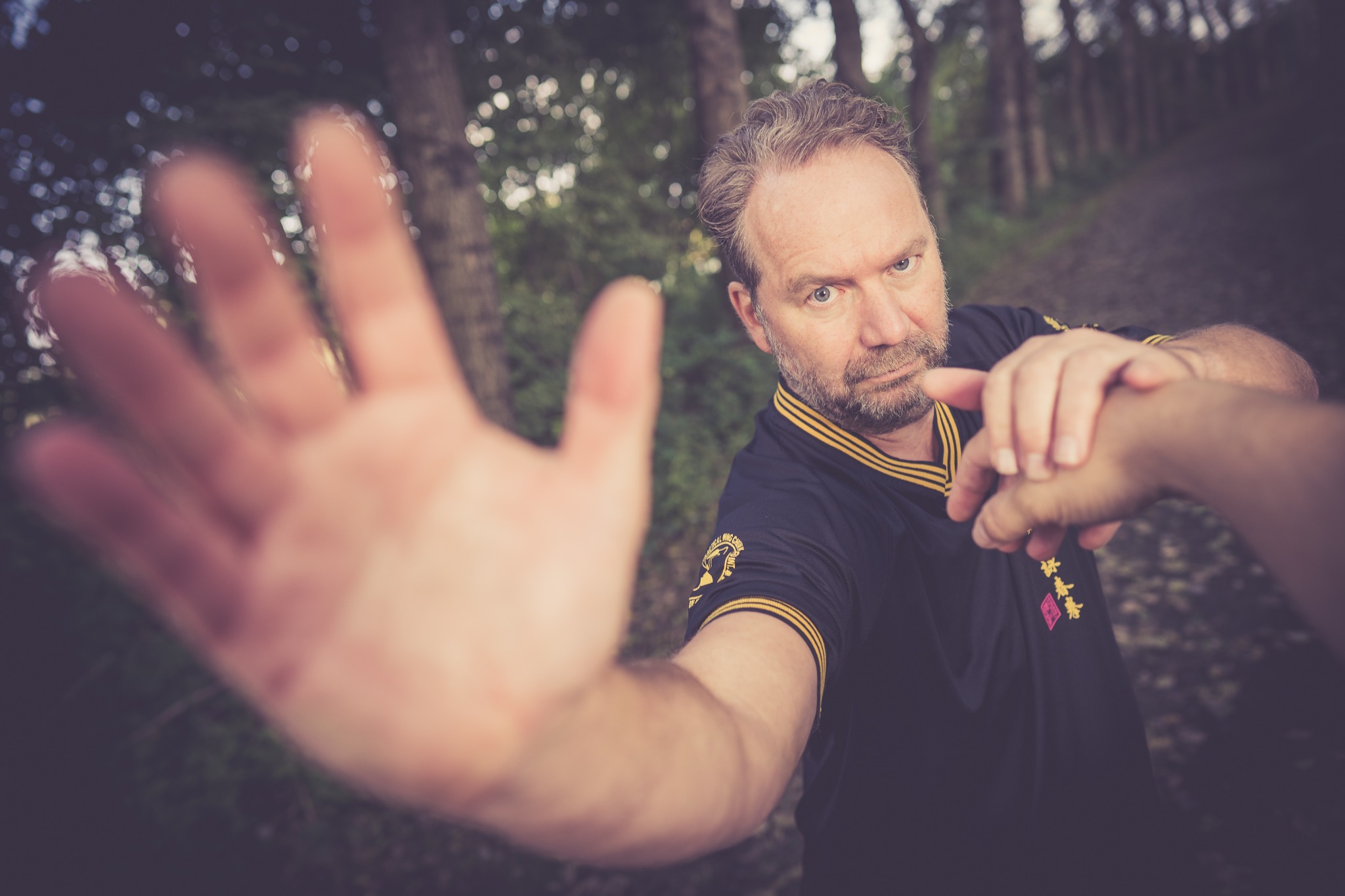
Siu Nim Tau: Where Wing Chun Begins
When people first encounter Siu Nim Tau, it can look deceptively simple. The practitioner stands in one place and performs a sequence of movements that seem modest compared with the more dramatic forms found in many martial arts. There are no large steps, no high kicks and no obvious display of power. Yet this apparent simplicity is exactly what makes the form so important.
Siu Nim Tau gives us nowhere to hide. Because the body is not rushing from one technique to the next, we are forced to look more closely at posture, alignment, elbow position, centreline, relaxation and the way force travels through the structure. It teaches the language that the rest of Wing Chun will later use.
For me, this has always been the real meaning of the first form. Siu Nim Tau is not a collection of basic techniques that we learn and then leave behind. It is the place where we begin to understand why Wing Chun works the way it does.
Principles before techniques
One of the most important lessons I took from my early Wing Chun training was that the art is not built around memorising an ever growing catalogue of answers. Wing Chun is based on principles. Techniques are expressions of those principles, not replacements for them.
This changes the way we practise. Instead of asking which technique belongs to a particular attack, we begin to ask what the situation requires. Where is the centre? Where is the pressure coming from? Am I balanced? Is my structure connected? Can I respond without adding unnecessary movement or strength?
Siu Nim Tau introduces these questions quietly. A Tan Sau, Fook Sau or Wu Sau may appear to be a simple hand position, but the more carefully we practise it, the more we discover that the hand is only the visible end of a much larger relationship involving the elbow, shoulder, torso, stance and ground.
This is where imitation begins to turn into understanding.
Structure, relaxation and centreline
Wing Chun is often associated with efficiency, and efficiency starts with learning not to solve every problem with muscular effort. If a movement only works when the arm is tense and the shoulder is working hard, something important is usually missing.
Siu Nim Tau gives us time to explore structure before speed and power complicate the picture. The stance connects us to the ground. The elbow gives the arm a relationship to the body. The wrist and hand remain functional without becoming rigid. The body begins to learn how to support a movement rather than leaving one muscle group to do all the work.
In my own training, the relationship between the elbow and the hip became particularly important. If attention goes only to the hand, the arm can easily become disconnected. When the elbow is positioned correctly, the arm has a clearer relationship to the rest of the body. The familiar angle of roughly 135 degrees is not interesting because a number itself is magical. It is useful because it helps preserve space, mobility and structure without locking the joint.
The objective is not to become stiff. A rigid structure may feel strong for a moment, but it loses the ability to adapt. What we want is a structure that remains alive and responsive.
Relaxation is equally easy to misunderstand. It does not mean becoming loose or passive. If the body collapses, the relationships that support the movement disappear. At the other extreme, excessive tension reduces sensitivity and makes movement slower and more predictable. The useful state lies somewhere between those extremes. The body does what is necessary, but no more than necessary.
The pace of Siu Nim Tau allows us to investigate that balance. We can notice whether the shoulder is rising, whether the elbow is drifting outward, whether the wrist is becoming rigid or whether the stance is being held through unnecessary effort. Slow practice makes weaknesses easier to feel. Speed can hide them.
Centreline theory belongs in the same conversation. The centreline is not only an imaginary line drawn down the front of a person. It is a way of understanding position, distance and relationship. If I control a useful line between myself and another person, I may be able to travel by a shorter route while forcing the other person to take a longer one. When the relationship changes, the useful line changes with it.
This is why centreline work is not simply about keeping the hands in the middle. It teaches us to think spatially. Where am I in relation to the other person? Which path is direct? Which position gives me control while still allowing me to move?
Over time, these questions turn Siu Nim Tau into training in subtle awareness. We begin to notice smaller changes in our own body and in the relationship with another person. That awareness is not separate from fighting skill. It is part of it. The earlier we notice change, the earlier we can respond to it.
A form to keep returning to
The first form remains relevant because its apparent simplicity keeps revealing new layers. A practitioner can return to Siu Nim Tau after years of training and find that the movements look almost the same while the experience of performing them has changed completely.
A Tan Sau practised in the first months of training may be understood mainly as a shape. Years later, the same movement may be felt through the stance, elbow, shoulder, centreline and intention at the same time. The external movement has barely changed, but the understanding behind it has.
This is also why later forms do not replace Siu Nim Tau. Cham Kiu adds movement and connection. Biu Ji adds refinement, recovery and increasingly subtle coordination. Both depend on the foundation established in the first form.
When I wrote The Book of Siu Nim Tau, I never intended it to represent a final statement about Wing Chun. It recorded my understanding at a particular stage of my own development. Training, teaching and writing continued to change the questions I asked and the way I understood the answers.
I think the same should be true of the form itself. Siu Nim Tau is not something to complete. It is something to revisit. Each return gives us an opportunity to look again at structure, relaxation, centreline, sensitivity and the relationship between the parts of the body. What once seemed basic becomes more subtle. What once seemed obvious becomes worth questioning again.
That is why Siu Nim Tau remains where Wing Chun begins, even after we have moved far beyond our first lesson. It gives us a foundation, but more importantly, it gives us a way to keep examining that foundation as our understanding grows.
Continue the journey
Continue with The Book of Siu Nim Tau
The article introduces some of the ideas that shaped my understanding of the first Wing Chun form. The book goes much further into the form, its movements, structure, terminology and the principles behind the practice.
Prefer a shorter introduction?
Download Structure in Wing Chun
The free 23-page eBook follows structure from Siu Nim Tau through Cham Kiu to Biu Ji.
Tags: Siu Nim Tau, Wing Chun, Practical Wing Chun, centreline, structure, relaxation, sensitivity, body mechanics.
For more about my approach to Practical Wing Chun, visit the Wing Chun Lelystad website, explore the Wing Chun terminology reference, or browse the My Personal Wing Chun Tao books.